
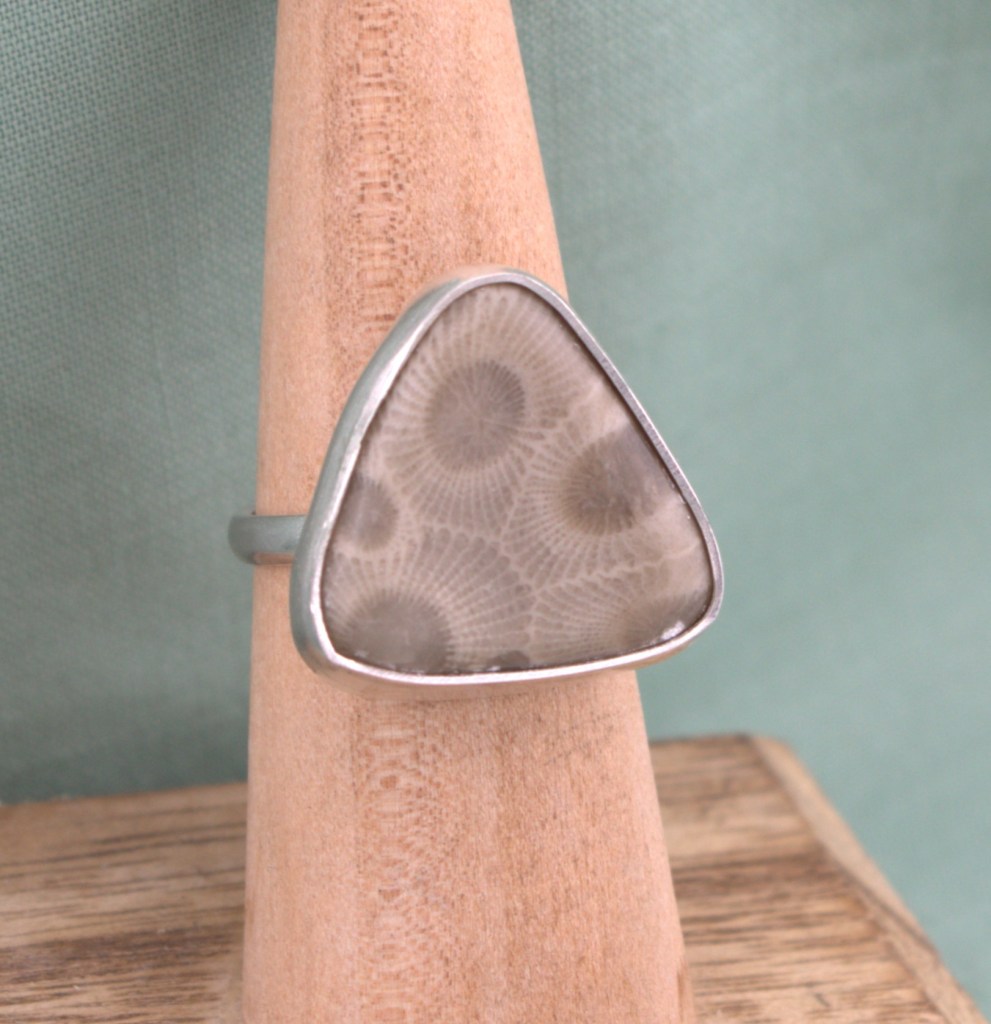
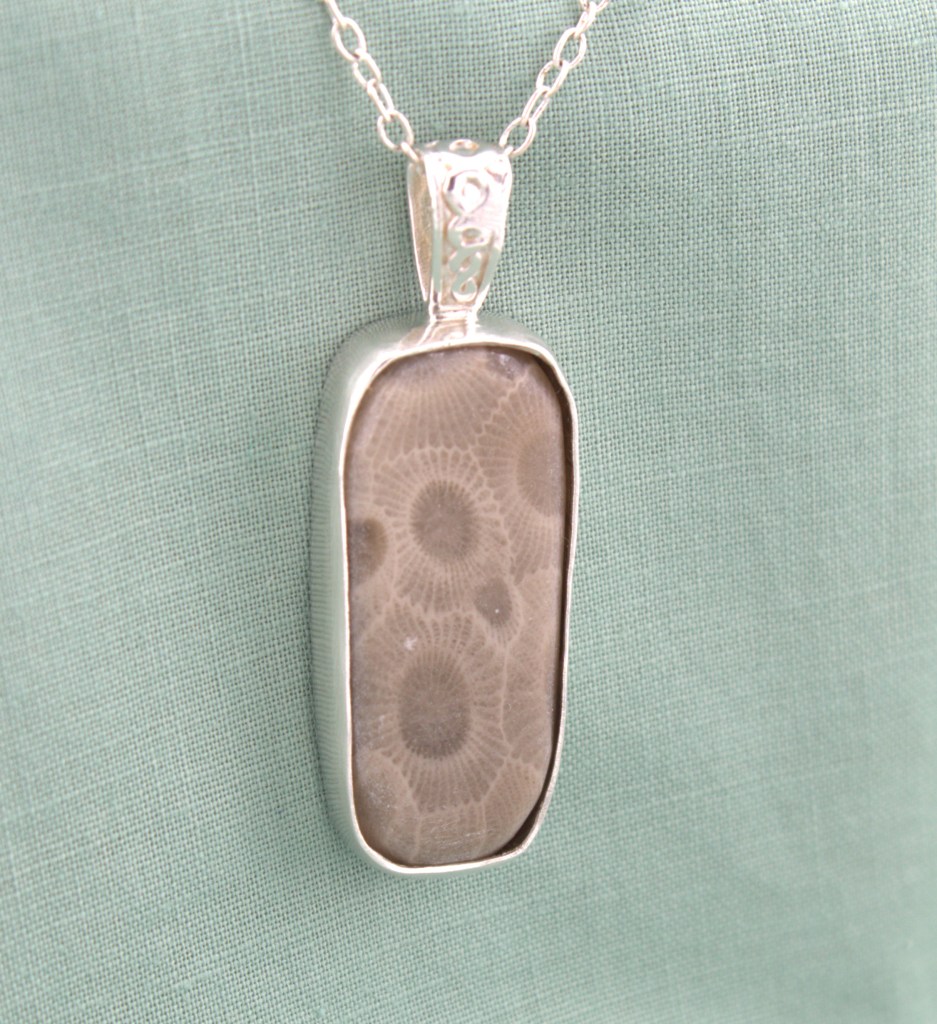
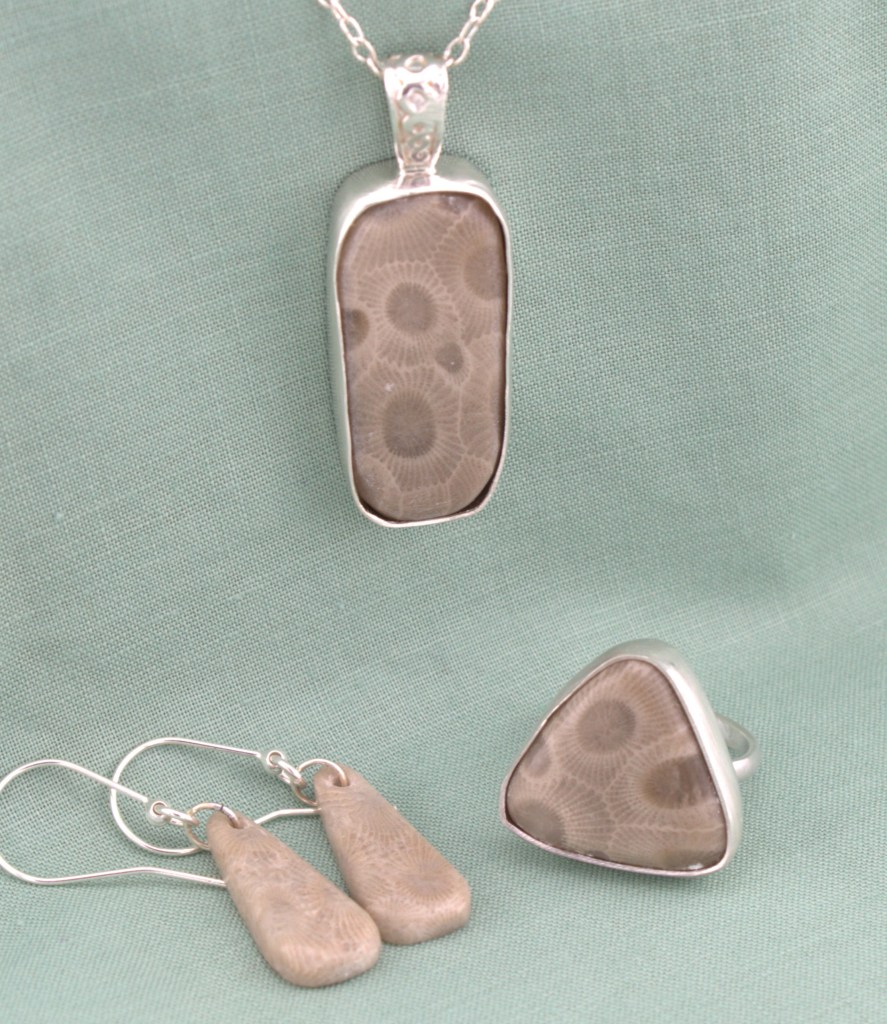
Petoskey jewelry is made from petrified coral, known as Petoskey stone. These are set in Sterling Silver.

History:
Well before dinosaurs roamed the earth, over 350 million years ago during the Devonian period, the land we know as Michigan was located near the equator. It was covered by a warm, shallow, saltwater sea. The colonial coral hexagonaria percarinata thrived with other marine life in tropical reefs. The earth’s plates moved and pushed Michigan north to the 45th parallel and above sea level. This movement created dry land formations. More recently, about two million years ago, glacial action scraped the earth and spread the fossils across the northern Lower Peninsula. These glaciers deposited major concentrations in the Petoskey area. The prehistoric fossil, unique to the Traverse Group rock strata, is called the Petoskey Stone. It became Michigan’s official state stone in 1965.
Pet-O-Sega, which means “Rays of the Rising Sun” in the Ottawa language, was the birth name given in 1787 to the son of a French fur trader and his Indian wife. Pet-O-Sega grew up in an area northwest of present day Harbor Springs. He became a respected landowner and businessman and, like his father, was recognized as an Ottawa Indian Chief. In 1873 the settlement on the Bear River was named Petoskey in his honor.
Petoskey became a summertime destination for Victorian tourists. The unusual fossil specimens were popular souvenirs. Study the Petoskey Stone and you’ll see in each cell the pattern of the “rays of the rising sun,” a romantic tie to the origins of the resort area. Besides that, “I’m bringing you a Petoskey Stone” was much easier to fit on a postcard than, “Wait until you see the Hexagonaria Percarinata I got you.”
In June of 1965 the Petoskey Stone was named Michigan’s official State Stone. Miss Ella Jane Petoskey, the only living grandchild of Chief Petoskey, attended the formal signing. In the city that bears his name, a bronze statue of the dashing Petoskey stands on a bluff overlooking Little Traverse Bay.
Petoskey hunting:
The most popular place for hunting Petoskey Stones is a Lake Michigan beach. Many say the best time of year is spring. Rockhounding is good from the springtime thaw until the snow flies late in the year.
Although the beaches are the hot spots, those ancient glaciers spread the fossils around the area. Rockhounds know to leave the lakeshore to search cut roadbeds, gravel pits and even farmer’s fields. It’s important to respect property lines and gain permission to hunt on restricted and private land.
Dry Petoskey Stones often appear as regular limestone, varying in shades from light grey to dark grey. The unique six-sided pattern, resembling “rays of the rising sun,” becomes visible when the stone is wet. This makes it easier to find Petoskey Stones along the shore or by wading into the water.