
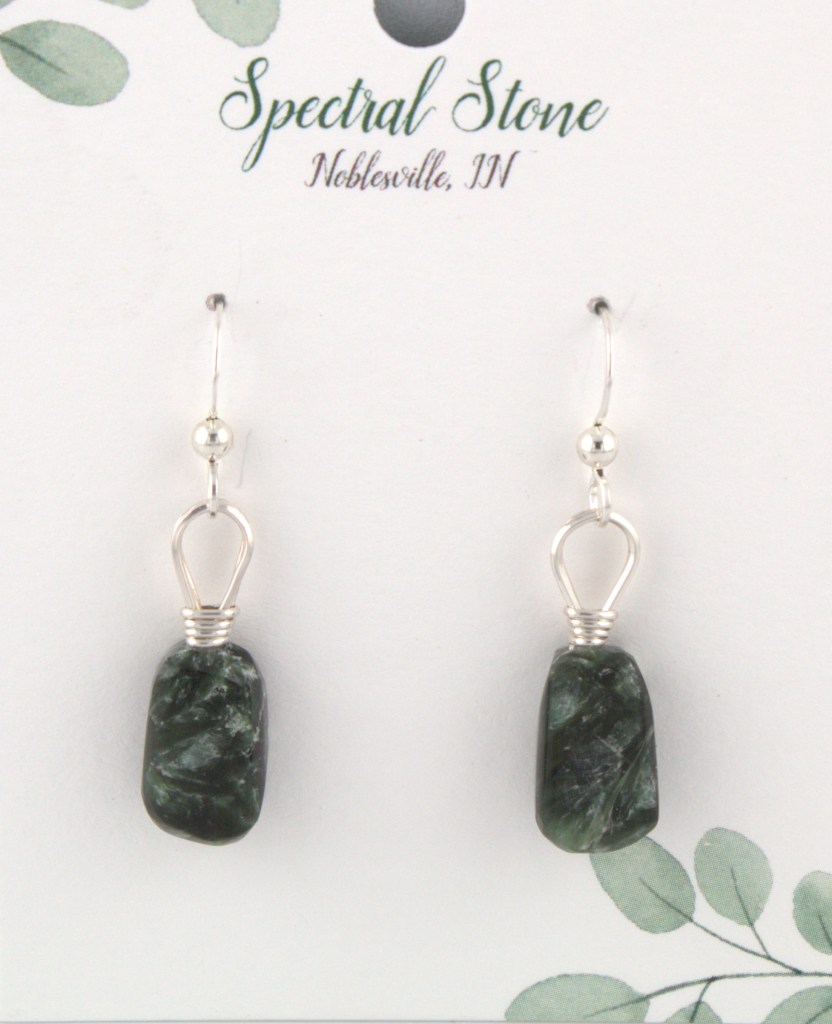
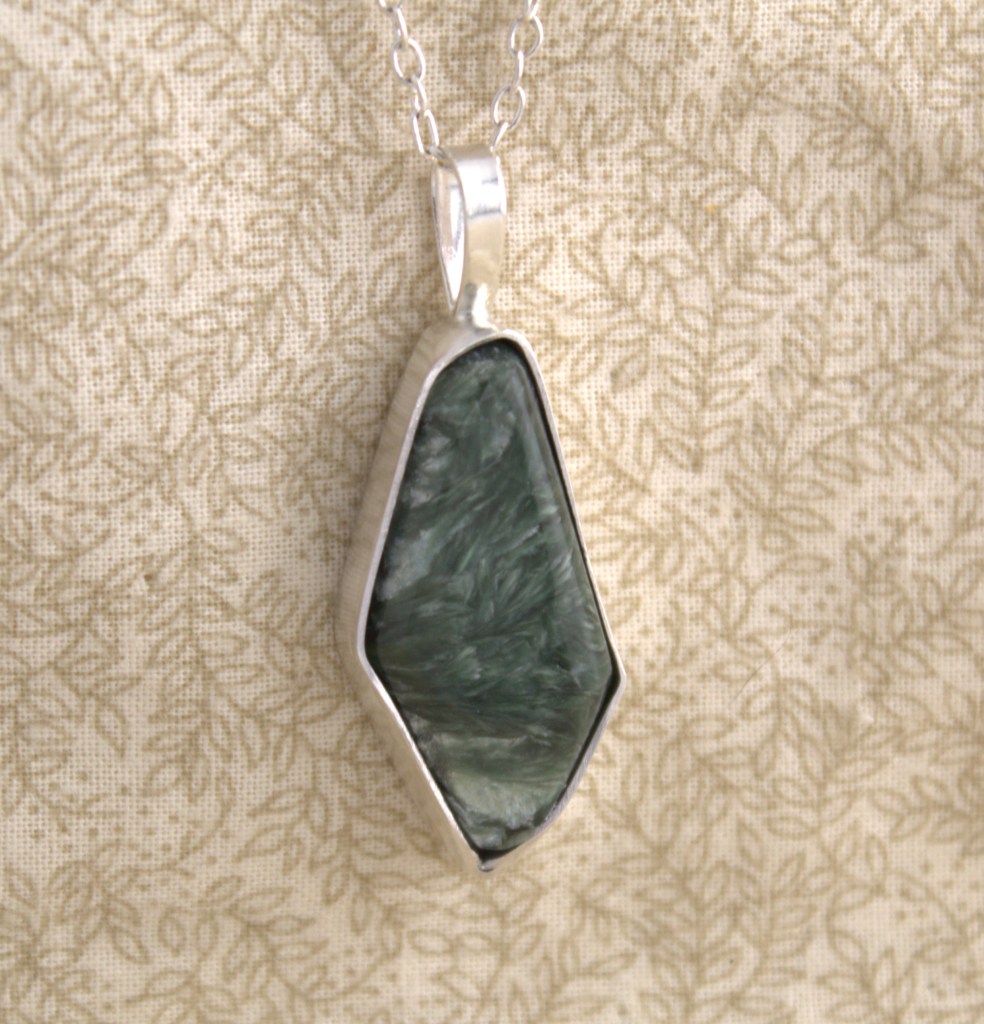
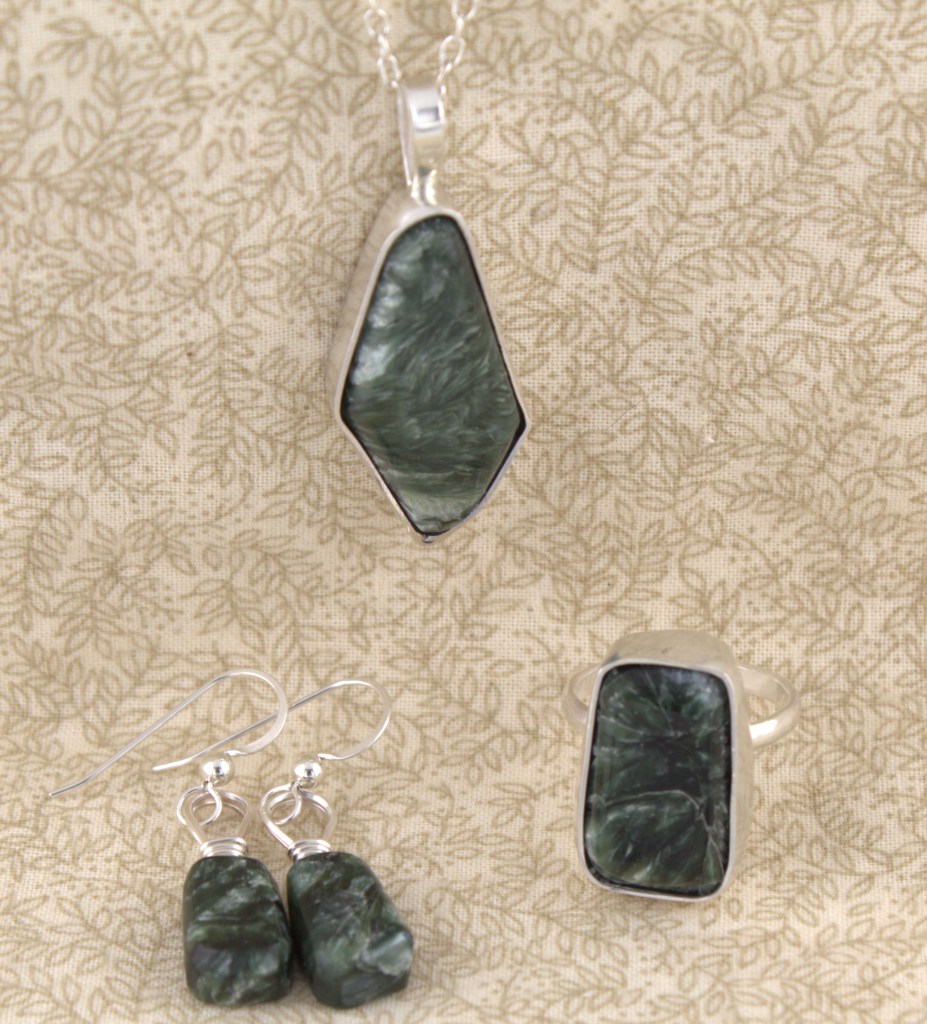
The name Seraphinite comes from the biblical seraphs or seraphim angels. It is mined in a limited area of eastern Siberia in Russia. Often called green chlorite, it’s typically a deep forest green with silvery, feather-like additions of mica.

History
The name of this natural stone Seraphinite was once called “chlorite jade” or “chlorite”, which comes from the Greek “kloros” meaning “green”. However, for commercial reasons, the name “chlorite” was abandoned and became “seraphinite”. This name comes from the Christian religion, which recalls a Seraphim, an angel with three pairs of wings, part of the high celestial hierarchy. However, the name “chlorite” is still used to designate the stone scientifically.
Seraphinite was first identified in 1851 in Pennsylvania, USA, by a Russian mineralogist, Nikolai Ivanovich. His work on Seraphinite enabled him to become director of the Imperial Mineralogical Society in St. Petersburg in 1865.
Unfortunately, very little information is available on this natural stone. Today, however, it is highly prized in jewelry and lithotherapy.
Seraphinite stone is associated with the heart chakra to amplify benevolence, happiness, self-confidence and love. In addition, this chakra promotes open-mindedness and the expression of feelings. It is also linked to the third eye chakra, which stimulates the body and mind by bringing calm, awareness and intuition. It also improves memory, clarity and tolerance.
Seraphinite is very close to the astrological signs of Taurus, Aquarius and Gemini.